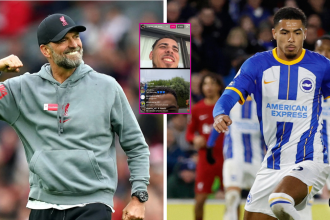
Jurgen Klopp's decision to step down as Liverpool boss rocked the world of football. The resurgent Reds were top of the Premier League and still in three cup competitions when the Kop idol announced on January 26, 2004 that he would leave Anfield at the end of the season.
"I can understand that it's a shock for a lot of people at this moment, when you hear it for the first time, but obviously I can explain it – or at least try to explain it," Klopp told the club's official website.
"I love absolutely everything about this club, I love everything about the city, I love everything about our supporters, I love the team, I love the staff. I love everything.
"But that I still take this decision shows you that I am convinced it is the one I have to take. It is that I am, how can I say it, running out of energy."
The supporters were stunned. There had been some signs of fatigue and frustration the year before but nobody had seen Klopp's imminent exit coming – not even Klopp's assistant Peter Krawietz…
Getty Images Sport'I understood Jurgen's explanations'
"Jurgen called me at the time and said I should come to see him. He said that we needed to discuss something," Krawietz explains in an exclusive interview with GOAL.
"When he told me what, I was initially surprised, but five minutes into our conversation, which ended up lasting perhaps two hours, I was no longer surprised.
"I completely understood all of Jurgen's explanations and arguments. They were logical, consistent, and also congruent with my own thinking.
"We had both taken a long look in the mirror, independently of each other, and in doing so, we came to the difficult conclusion: a four-week break would not be enough to face the challenges of the following season, in light of everything that this profession requires."
AdvertisementGetty Images SportKlopp's surprise move
In truth, it wasn't that difficult to understand why Klopp might be exhausted. After all, he was renowned for his intensity.
Klopp was never less than 100 percent committed to the cause – whether that was at Mainz, Borussia Dortmund or Liverpool – so it was perhaps inevitable that such a relentless work ethic would eventually catch up with him.
Nobody was in any doubt that he deserved an extended break from football either. For that very reason, though, eyebrows were raised when Klopp announced his return to the game less than six months after his final game at Anfield – and as Red Bull's head of global soccer.
Klopp had always claimed to be a traditionalist, an old romantic disillusioned by the commercialisation of football, so his decision to accept a role within the sporting department of the energy drink manufacturer provoked accusations of hypocrisy and selling his soul.
Getty Images'At Red Bull, Jurgen can think outside the box'
Krawietz, though, insists that he wasn't at all surprised by the timing of Klopp's return to work or the identity of the employer.
"I would have only been surprised if he had asked me if we wanted to join a certain club in our usual roles," he says. "But I was almost certain that wouldn't happen.
"I always thought that he would do something completely different than before. Jurgen simply wanted a change from his coaching job.
"He's always been a very curious person, enthusiastic about other things, and, at Red Bull, he can think outside the box, experience new things, really get involved, isn't tied to one location, and is free of the daily public relations work. It's less intensive, but just as extensive.
"I've taken note of the criticism – but I don't understand it. I think there's a bit of a misunderstanding on the part of the fans [in Germany].
"In England, it's perfectly normal for a club to be managed by an investor who acts as a financier and makes strategic decisions.
"If you ask yourself why this hasn't yet taken hold in Germany, it also raises the question of how professional and commercially marketed football can be. A highly interesting discussion, but one as old as football itself.
"But, at the end of the day, where would Jurgen have been allowed to work, what would the public have approved of? There would have been numerous critical voices even if he had – purely hypothetically – become coach at Bayern Munich or Manchester United.
"Of course, that's not how free choice of profession works. You have to pay respect to an individual. You can't hold a public vote on what the fans would like."
getty'True champion' James Milner
Of course, Klopp's status as a Liverpool legend has long been secure. He enjoyed a wonderful rapport with the fans – and still does.
Winning trophies obviously helped. As well as leading the Reds to a sixth European Cup, Klopp also ended Liverpool's 30-year English title drought.
Krawietz openly admits, though, that the management team owed so much of their success to a wonderful group of players, men of real character that created and maintained a standard of excellence at the club.
"I don't want to put anyone above others and could probably talk about each one for an hour," Krawietz says, "but, in terms of the focus on daily life, the job, and the complete conviction with which you approach it, the shining example and the most professional of all the players I've met is James Milner.
"He managed to align an entire team around this focus and demonstrate how to become a true champion."